

Free MATLAB Alternatives — Octave, Python, Scilab and When Each One Is Right
MATLAB is the tool most engineers learned on at university, and a private licence is hard to justify after graduation. The question is not "what is most like MATLAB" but what exactly you used it for: running someone else's old code, new numerical work, symbolic algebra, or figures for a paper. Each of those has a different free answer.
If you have MATLAB code that simply has to run
1. GNU Octave
This is the direct answer. Octave was built to be compatible with MATLAB syntax, so existing scripts usually run with little or no change — the same matrices, the same 1-based indexing, the same core functions. It has a GUI, a command window and plotting.
What is missing: there is no Simulink and no real substitute for it, and the commercial toolboxes are not supported. Code that leans on a specific toolbox will not carry over. Performance on heavy loops is also weaker.
2. Scilab
A standalone numerical environment with its own language (not MATLAB-compatible), but with one big advantage: Xcos, a block-modelling environment that is the closest open counterpart to Simulink. If what kept you on MATLAB was control block diagrams, look here first.

GNU Octave
GNU Project
Numerical computing in MATLAB-compatible syntax — matrices, equations, signals and plots.
Get it from the vendor
Scilab
Dassault Systèmes / Scilab Enterprises
Numerical computing with Xcos — block-diagram simulation of dynamic systems alongside scripting.
Get it from the vendorIf you are writing new code — do not imitate MATLAB
3. Python with NumPy, SciPy and Matplotlib
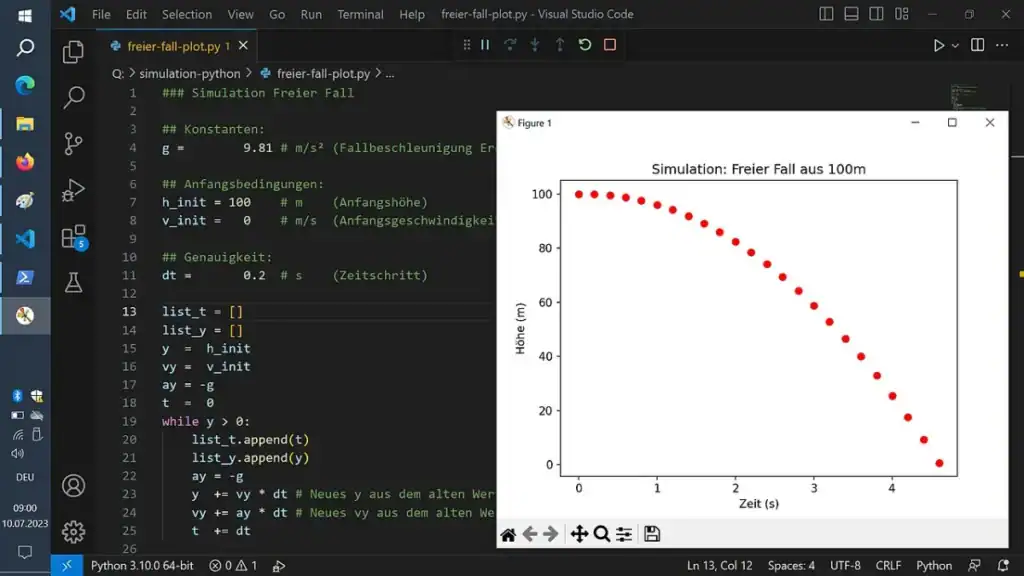
This is the real long-term recommendation. NumPy gives fast arrays, SciPy gives integration, optimisation, linear algebra, signal processing and statistics, and Matplotlib gives publication-quality figures. Above them sits everything else: pandas for data, SymPy for symbolic work, and most of the engineering tools in this directory can be driven from Python.
What is missing: there is no single box — you have to assemble an environment. And moving from MATLAB means getting used to 0-based indexing and a slightly different vectorised way of thinking.
4. Pyzo
If that assembly sounds off-putting: Pyzo is a light working environment that pairs an editor with an interactive shell in a MATLAB-like style, without the weight of a full IDE. It works with any Python installation you already have.

Python
Python Software Foundation
The language behind most modern engineering computation, and its full ecosystem.
Get it from the vendor
Pyzo
Pyzo Project
A lightweight Python environment for scientific and engineering work.
Get it from the vendorSymbolic algebra
5. Maxima
The counterpart to the Symbolic Math Toolbox: analytic differentiation and integration, solving equations and systems, series, transforms and symbolic matrices. Old, stable and precise. If you need a closed-form expression before you put numbers in, this is the tool.

Maxima
Maxima Project
Computer algebra — analytical solving, differentiation and integration, simplification and matrices.
Get it from the vendorFigures for reports and papers
6. gnuplot
When a plot has to be generated automatically from a solver's output or a measurement rig, gnuplot is the choice: a few lines of script, export to PDF, SVG, PNG and LaTeX-friendly formats, and exactly the same result on every run.
For visualising 3D solver results — fields, slices, isosurfaces — the right tool is ParaView, not MATLAB and not gnuplot.

gnuplot
gnuplot Project
Publication-quality plotting driven from scripts.
Get it from the vendor
ParaView
Kitware / Sandia / Los Alamos
Large-scale simulation post-processing — slices, streamlines and animation.
Get it from the vendorSpecialist libraries that replace a whole toolbox
Part of what people pay for in MATLAB is data, not code:
- CoolProp — thermophysical properties for hundreds of fluids and refrigerants, callable from Python, MATLAB or Excel. It replaces tables and charts.
- Cantera — chemical kinetics, equilibrium and transport properties, for anyone working on combustion or electrochemistry.
- OpenModelica — multi-domain physical system modelling with a graphical editor; a serious alternative to Simulink in the mechanical, hydraulic and thermal world.

CoolProp
CoolProp Project
Thermophysical property data for over a hundred fluids, callable from any language.
Get it from the vendor
Cantera
Cantera Developers
Chemical kinetics, thermodynamics and transport, callable from Python or MATLAB.
Get it from the vendor
OpenModelica
Open Source Modelica Consortium
Simulate multi-domain physical systems with the Modelica language.
Get it from the vendorWhat to choose
You have old code that must run tomorrow — Octave. You are building something new that will follow you for a decade — Python. You stayed on MATLAB for Simulink — Scilab/Xcos or OpenModelica. You need an analytic expression — Maxima.
The common mistake is looking for an exact clone of MATLAB. Octave is the closest, but moving to Python is what pays off in the long run, because it also opens up every other tool in this directory.
All numerical tools on the site: numerical computing and programming.